Most stories die in notebooks
 Adelina Persa
Most of us carry experiences we never manage to share. Not because they don’t matter, but because finding the words is hard. Writing is hard. Even for the people who are great at it. Look at this page.
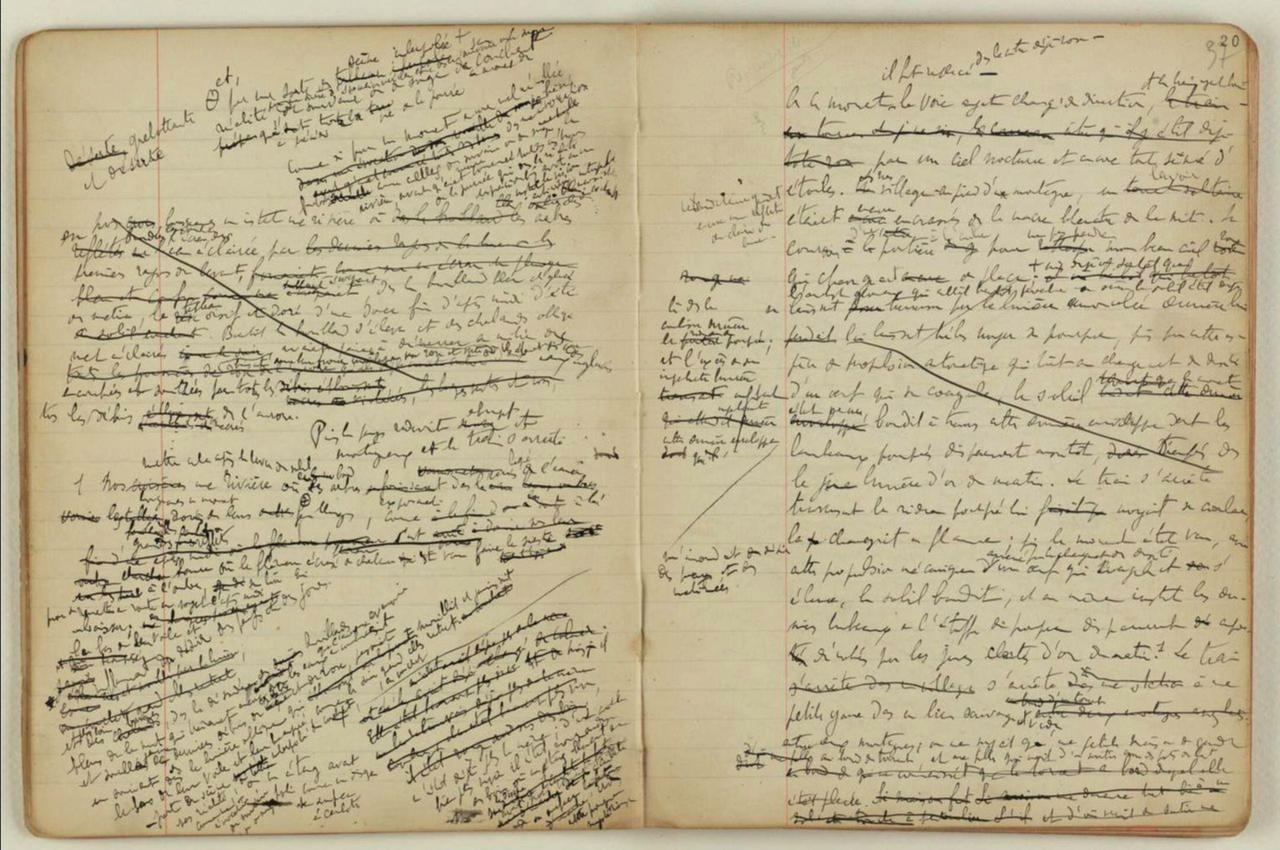
This is Marcel Proust’s manuscript for A la recherche du temps perdu, one of the most celebrated novels ever written. It’s a mess. Crossed-out lines, additions scrawled in the margins, sentences rewritten on top of themselves, entire paragraphs pasted over others. This is what writing actually looks like before it becomes the thing you read in a book. It’s chaotic, layered, and deeply human. And if Proust worked so hard to find what he wanted to say, I think the rest of us can relax a little.
This is strangely freeing for me. Not everyone is a writer, I don’t consider myself one, but everyone has something worth expressing. Once I stopped overthinking and started treating writing as a process, something shifted. I want to share more, not less. Not because I suddenly found the right words but because I realised that the messy search for them is the whole point. It might involve staring at a blank page long enough to question your life choices, but it’s worth it.
Last year, I had an experience I wanted to share with more people, the experience of swimming with orcas in the Arctic Fjords of Norway. I still had vivid memories: the cold biting my body, the dark waters, the sharp exhale of an orca’s breath, the black and white bodies weaving through an enormous school of herring, the moments of frustration, fear and cold, what it taught me. I had notes in a small physical notebook full of half formed ideas, words to describe my feelings, a Susan Sontag quote about how safety breeds indifference that resonated with the experience. I had everything I needed except the only thing that actually matters: a way to get it out in a form that someone else could read (you’ll be able to read it towards the end of this article).
Every time I tried, the same thing happened. I would open a blank document and pour everything out in a kind of manic, emotional rush, chaotic, unstructured, raw. My own little Proust manuscript, minus the genius. By the time I reached the end, I felt emptied, as if the act of expression itself was the goal. And maybe it was, because that’s how most of my stories die: chaotic, untold, unshared. They live only in my head. The worst part wasn’t the failed untold stories, it was the feeling that the experience was fading while I fumbled with it. Every week the memories got a little less sharp, a little more like something I read about rather than something that I lived. I started to forget, the experience was slipping away, and I wasn’t doing anything to hold onto it. That was scarier than writing badly. This time I tried something different. Not because the writing was easier, but because the process around it changed. This is where BlueTip came in.
From writing to editing, or learning to detach from your work
After days of failed attempts, I finally had a raw draft that I didn’t hate. It wasn’t good, it was too long, repetitive, still emotionally all over the place, but the whole experience was on the page. That felt like progress. But having a draft and having finished work, these are very different things. The raw version had too much in it, which was exactly the problem. I needed to shift from writing to editing. This is the hardest transition for me. I cannot evaluate something clearly while I’m still emotionally attached to it.
BlueTip is an AI-powered writing tool built around the idea that the writing should stay yours and it offers different ways to review, restructure, and refine your work. One of its features, Read Out Loud, is the one that changed my editing process. When you hear your writing instead of silently scanning it, the illusion that it “sounds fine” collapses almost immediately. You hear the awkward phrasing, you notice where the energy drops, you catch missing words your brain has been auto-correcting.
I remember hearing myself use the word “profound” a couple of times in two consecutive paragraphs. What felt deep and considered on the page sounded repetitive and slightly pretentious out loud. That’s the kind of thing you can’t catch with your eyes, the brain smooths it over, but the ears don’t.
Listening to your own writing is like stepping outside of it for a moment, suddenly you are not the author, you’re the audience. That distance changes everything, it gives clarity and objectivity. I cut sentences, tightened paragraphs, reshaped transitions, sometimes changed the story line entirely. Each listening pass revealed something new. Editing stopped feeling like a chore and became almost physical, like tuning an instrument.
Reverse outline, or discovering the structure I didn’t know I’d written
My biggest struggle has always been structure. My first drafts are emotional landscapes.
BlueTip’s Reverse Outline feature let me finally see the architecture of what I’d written. A reverse outline works backwards, instead of asking “what do I want to say?” it asks “what did I actually say?”. That distinction matters more than it sounds. The tool extracts the core idea of each paragraph after you’ve written the draft, and lays the skeleton out in front of you.
Once I could see the story broken down, the problems were obvious. I’d written an entire paragraph about orca social structures, how sons stay with their mothers for life, how knowledge is passed through generations, that was fascinating, but completely killed the pace of the story. Some reflections interrupted narrative momentum, some themes were introduced but not developed, some paragraphs were saying the same thing in different clothes. And once I could see the skeleton, I could work on it more intentionally - move things, cut things, let the story breathe where it needed to.
The Writing Professor, the friend you need
Early feedback is invaluable. Everyone says so. Everyone also says you should share your work early and often. What they don’t mention is that sharing a vulnerable draft too soon can feel like showing up to a party underdressed, technically fine, practically excruciating.
BlueTip has a feature called the Writing Professor, and to be honest, it’s not gentle. The first time I used it, it told me my ending was weak and that my strongest idea was underdeveloped. It was hard to read. My first instinct was to disagree with all of it. My second instinct, after taking a break and breathing a bit, was to realise it was mostly right, at least on challenging me. That is what makes it so useful. The feedback is blunt, sometimes very uncomfortable to digest, but it’s never prescriptive. It didn’t rewrite my voice, it asked questions and made suggestions, creating exactly the friction I needed without the exposure of handing a messy draft too early to somebody who would remember my mistakes later at dinner.
Clarity and correctness, the non-native speaker’s quiet battle
There’s a subtle but significant difference between correcting mistakes and rewriting someone’s voice. As a non-native English speaker, Romanian is my first language, I live in this gap constantly. My brain still thinks in Romanian sometimes, and when it does, the sentences come out with a rhythm and logic that makes perfect sense to me and not so much to an English reader. Sometimes a sentence feels emotionally right, but is technically off. Sometimes the technically correct version kills the feeling entirely. Anyone who writes in a second language knows this is a negotiation, you are not just choosing words, you are choosing which version of yourself sounds most like you.
BlueTip’s clarity and correctness tool catches the kind of mistakes that I am too close to see: misplaced articles (the eternal nightmare for a Romance language speaker), subtle grammar slips, constructions that are perfectly logical in Romanian and baffling in English. With those out of the way, I could focus on what the story was actually trying to say, instead of spending half of my editing time staring at the same sentence wondering if it’s actually correct or just feels correct. I decided which suggestions to accept, which to ignore, and which to note for later. That level of control matters. This should feel like my writing with better grammar, not someone else’s writing with my name on it. The relief of not second guessing every preposition is hard to explain to someone who hasn’t experienced it, but if you know, you know.
At some point during the process, I can’t say exactly when, I read the piece back and something felt different. Not perfect, not finished, but the words matched the memory. The cold was there, the orcas were there, the fear, the dark waters, the moment the sickness stopped mattering, all of it was on the page. Not a version of me trying to be a writer, just me, telling someone what happened. And this is what I wanted to achieve all along.
Hit the publish button before you talk yourself out of it
No piece of writing ever feels finished. If you revisit something a year later and you don’t see ways to improve it, you probably haven’t grown. The discomfort of seeing flaws in older work isn’t failure, it’s evidence of improvement. At some point, you decide the piece represents who you are now. Not perfectly, but honestly. And then you share it.
The story about my experience with the orcas could have stayed in my notebook. It could have remained a memory, unshaped and private, slowly fading. But I wanted to share it. First, for myself. And second, I wanted someone to read it and think: maybe I should go see these animals for myself, maybe I should care about what happens around me more, maybe I should do something that scares me a little. You can read it here and tell me what it made you think or feel.
BlueTip didn’t write the story for me. It helped me get it into a form that could be shared, and that distinction is everything.
Writing will always require vulnerability, it will always require effort, but it doesn’t have to feel isolating. Sometimes the difference between an unwritten story and a published one isn’t talent, it’s the process. And once you find the right process, stories start to take form.
I’d like to invite you to find yours. BlueTip exists to help with that, to bring more creative work into the world, so that more voices are heard, and fewer stories die in notebooks.